
About This Guide
For anyone moving from arithmetic to solving for an unknown. It covers the quadratic formula and discriminant, shows how exponents, roots and logarithms are three views of one relationship, and explains where scientific notation and matrices fit.
Arithmetic asks "what's the answer". Algebra asks "what value would make this true".
That's the whole shift, and it's a smaller one than most people remember. You've been doing it since primary school — every time you thought "what plus 7 gives 12", you were solving for an unknown. Algebra just gives that unknown a name and a set of reliable techniques.
The Algebra & Equations group covers six tools. Here's what each is for, followed by the quadratic formula worked through properly and the one insight that makes three of these tools stop feeling like separate subjects.
| Tool | Answers the question |
|---|---|
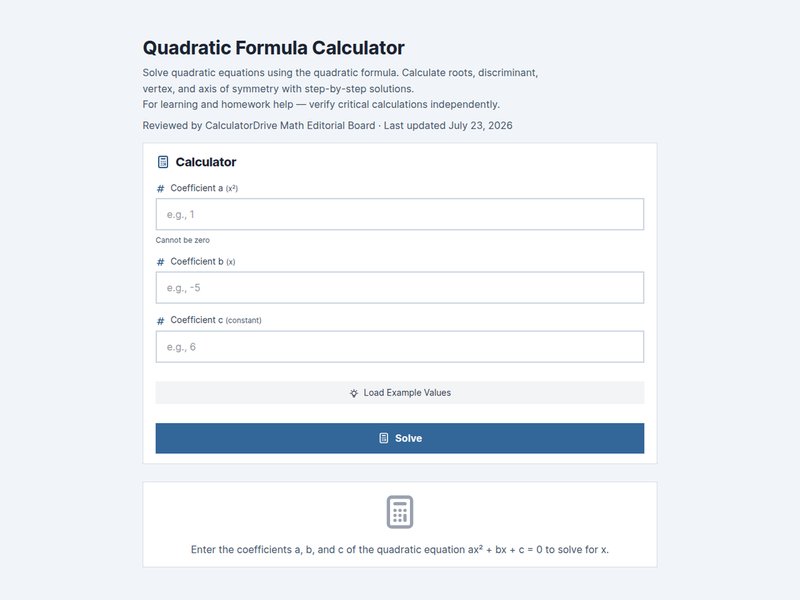
| Quadratic Formula Calculator | What values of x solve ax² + bx + c = 0? |
| Exponent Calculator | What is this number raised to that power? |
| Root Calculator | What number, raised to that power, gives this? |
| Log Calculator | To what power must I raise the base to get this? |
| Scientific Notation Calculator | How do I write a huge or tiny number without counting zeros? |
| Matrix Calculator | How do I add, multiply or invert a grid of numbers? |
Solving quadratic equations
A quadratic is any equation you can write as ax² + bx + c = 0, where a isn't zero. They turn up whenever something squared is involved — areas, projectile paths, braking distances, profit curves.
One formula solves every single one of them:
x = (−b ± √(b² − 4ac)) ÷ 2a
Worked example: 2x² + 5x − 3 = 0
Here a = 2, b = 5, c = −3. Take it in stages rather than all at once — that's where errors creep in.
- Discriminant first: b² − 4ac = 25 − (4 × 2 × −3) = 25 + 24 = 49. Watch that sign carefully. Subtracting a negative adds, and this is where most marks get lost.
- Square root: √49 = 7.
- Both branches: x = (−5 ± 7) ÷ 4
- x = (−5 + 7) ÷ 4 = 2 ÷ 4 = 0.5
- x = (−5 − 7) ÷ 4 = −12 ÷ 4 = −3
Now substitute both back in, because it costs ten seconds and settles the matter. For x = 0.5: 2(0.25) + 5(0.5) − 3 = 0.5 + 2.5 − 3 = 0. For x = −3: 2(9) − 15 − 3 = 18 − 18 = 0. Both work.
The discriminant tells you the answer's shape in advance
That b² − 4ac term is worth calculating on its own before you commit to the rest, because its sign alone tells you what you're dealing with:
- Positive → two distinct real solutions. The curve crosses the x-axis twice.
- Zero → one repeated solution. The curve just touches the axis and turns back.
- Negative → no real solutions. The curve never reaches the axis at all.
A practical note: if you get a negative discriminant on a homework problem, check your signs before concluding the question is unsolvable. A mis-copied minus sign is far, far more likely than a textbook setting an impossible exercise.
Try factoring first — it's often quicker
The formula always works, which doesn't make it always fastest. For x² − 7x + 12 = 0, look for two numbers that multiply to 12 and add to −7. That's −3 and −4, so the equation factors to (x − 3)(x − 4) = 0, giving x = 3 or 4 in a single line.
The formula agrees, of course: discriminant 49 − 48 = 1, so x = (7 ± 1) ÷ 2, which gives 4 and 3. Worth trying to factor for fifteen seconds before reaching for the formula — when it works, it's much faster.
Exponents, roots and logs are one relationship
These three get taught as separate topics, usually in separate chapters, and it makes them far harder than they need to be. They're the same statement read three different ways.
Start with one fact:
210 = 1,024
Three questions can be asked about it, and each hides a different unknown:
- Exponent: "2 to the power 10 is what?" → 1,024. That's the exponent calculator.
- Root: "What number to the power 10 gives 1,024?" → 2. That's the root calculator.
- Logarithm: "2 to what power gives 1,024?" → 10. That's the log calculator.
Three tools, one relationship, three different missing pieces. Once that lands, a good chunk of algebra stops being memorisation and starts being obvious.
Exponents in practice
- 34 = 3 × 3 × 3 × 3 = 81
- Anything to the power 0 is 1. So 50 = 1, which looks like a trick until you see why below.
- A negative power means a reciprocal, not a negative answer: 2−3 = 1 ÷ 23 = 0.125.
- Growth compounds through exponents. 5% a year for ten years is 1.0510 = 1.6289 — a 62.89% total increase, considerably more than the 50% you'd get by multiplying 5% by 10.
Roots in practice
- √225 = 15, because 15² = 225
- The cube root of 729 is 9, because 9³ = 729
- The 4th root of 625 is 5, because 54 = 625
Logarithms in practice
- log2(64) = 6, because 26 = 64
- log10(1,000) = 3, and log10(0.001) = −3
- ln(e) = 1, since the natural log uses base e (about 2.71828)
Logs turn multiplication into addition, which is why they sit underneath every scale that has to span an enormous range — decibels, pH, earthquake magnitudes. On a base-10 log scale, moving up one unit means the underlying quantity got ten times bigger. That's why a magnitude 7 earthquake isn't "a bit worse" than a magnitude 6.
Scientific notation
Once numbers get very large or very small, writing them out becomes unreadable and genuinely error-prone — miscount the zeros once and you're out by a factor of ten. Scientific notation writes any number as a value between 1 and 10, multiplied by a power of ten:
- 149,600,000 km → 1.496 × 10⁸ km (the distance to the Sun)
- 0.00000042 → 4.2 × 10⁻⁷
- 602,000,000,000,000,000,000,000 → 6.02 × 10²³
A positive exponent moves the decimal point right, a negative one moves it left. The scientific notation calculator converts both directions, and it pairs naturally with significant figures — our rounding guide covers that side of it.
Matrices
A matrix is a grid of numbers handled as a single object. They're how systems of equations, graphics transformations and large data operations get expressed compactly — every 3D rotation on your screen is matrix arithmetic.
Addition is straightforward: element by element, and both matrices must be the same shape. Multiplication is where intuition fails. It's not element by element — it combines rows with columns, and the first matrix's column count has to match the second's row count.
Which leads to the fact that surprises everyone: matrix multiplication isn't commutative. A×B and B×A generally give different results, and quite often only one of them is even defined. Order matters, in a way it never does with ordinary numbers.
For a 2×2 matrix [[3, 8], [4, 6]], the determinant is (3×6) − (8×4) = 18 − 32 = −14. A non-zero determinant means the matrix can be inverted, which is exactly what lets you use it to solve a linear system. The matrix calculator takes care of the arithmetic.
The mistakes worth watching for
- Sign errors in the discriminant. When c is negative, −4ac becomes an addition. This is the most common quadratic mistake by a wide margin.
- Forgetting the second root. The ± means two answers unless the discriminant is exactly zero.
- Reading 2−3 as negative. It's 0.125 — a positive fraction, not −8.
- Assuming A×B = B×A for matrices. It usually doesn't.
- Not substituting your answers back. It's the only check that catches a slip made halfway through.
Frequently asked questions
What is the quadratic formula?
x = (−b ± √(b² − 4ac)) ÷ 2a. It solves any equation in the form ax² + bx + c = 0, whether or not it factors neatly.
What does the discriminant tell me?
The sign of b² − 4ac tells you how many real solutions exist before you finish the calculation: positive gives two, zero gives one repeated root, negative gives none.
What's the difference between a root and a logarithm?
A root finds the base when you know the power; a logarithm finds the power when you know the base. For 210 = 1,024, the 10th root of 1,024 is 2, while log2(1,024) is 10.
Why is anything to the power of zero equal to 1?
Because dividing a power by itself gives 1, and the exponent rule turns that division into a subtraction: 34 ÷ 34 = 34−4 = 30. Any number divided by itself is 1, so 30 must be 1.
Why doesn't matrix multiplication work both ways round?
Because multiplication combines the rows of the first matrix with the columns of the second, so swapping them changes what gets combined with what. Often the dimensions won't even allow the reversed version.
Are these algebra calculators free?
Yes. Every tool linked here is free, needs no sign-up, and runs in your browser. They're all listed on the math calculators page.
How We Created This Guide
Every root and value was computed programmatically and verified by substituting the answers back into the original equation — the same check we recommend in the guide. Discriminant outcomes were confirmed across positive, zero and negative cases.
Sources & References
Formulas, conventions and worked examples in this guide follow standard mathematical references and published standards bodies:
Accuracy note: Worked examples here are rounded for readability, and calculators can legitimately disagree in the last decimal place because of floating-point storage and differing rounding rules. For graded coursework or financial reporting, follow the rounding convention your instructor, standard, or regulator requires.
Written by
sami
No comments yet. Be the first to comment!