
About This Guide
For students and parents who need the method rather than just the answer. It walks through the divide-multiply-subtract-bring-down cycle on real numbers, covers two-digit divisors and decimal answers, and shows how to check every result.
Long division is the piece of school arithmetic most adults have quietly forgotten, and it stays forgotten right up until a ten-year-old slides a workbook across the kitchen table and asks for help.
Here's the thing worth noticing: if you only wanted the answer, you'd use the basic calculator and be done in two seconds. You're doing it longhand for one of three reasons — you need to show the working, you want a remainder rather than a decimal, or someone else has got stuck halfway and you need to find out where.
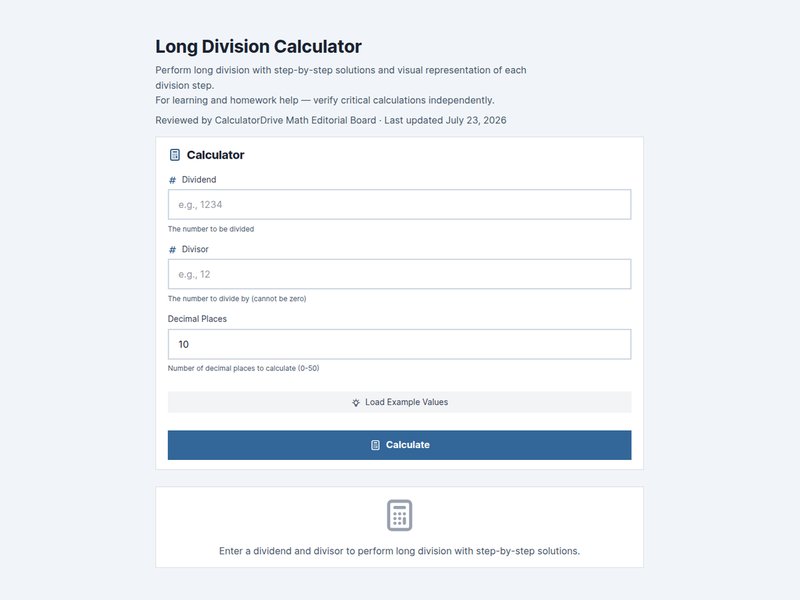
So this guide is about the method, not the number. Work through it alongside the long division calculator if you want to compare each step against your own.
The words, quickly
Four terms, and knowing them makes every explanation elsewhere easier to follow:
- Dividend — the number being divided, sitting inside the bracket
- Divisor — the number you're dividing by, outside the bracket
- Quotient — the answer, written on top
- Remainder — whatever's left over when you run out of digits
The cycle: divide, multiply, subtract, bring down
Every long division is that same four-step loop, repeated until the digits run out. Once you see it as a loop rather than a procedure to memorise, it stops being intimidating — you're doing the same small thing over and over.
Worked example: 947 ÷ 8
- 9 ÷ 8 goes 1 time, with 1 left over. Write 1 above the 9. (1 × 8 = 8, and 9 − 8 = 1.)
- Bring down the 4 to make 14. 14 ÷ 8 goes 1 time, 6 left over. Write 1. (1 × 8 = 8, and 14 − 8 = 6.)
- Bring down the 7 to make 67. 67 ÷ 8 goes 8 times, 3 left over. Write 8. (8 × 8 = 64, and 67 − 64 = 3.)
- No digits left. That 3 is your remainder.
947 ÷ 8 = 118 remainder 3.
Every single step was one of: divide, multiply, subtract, bring down. That's the whole algorithm.
Always check by multiplying back
This is the habit worth building, and it takes about five seconds. Multiply your quotient by the divisor, add the remainder, and you must land back on the dividend.
8 × 118 = 944, and 944 + 3 = 947. Correct.
That one check catches nearly every arithmetic slip you can make. A clean example with nothing left over: 4,728 ÷ 12 = 394, and 12 × 394 = 4,728 confirms it immediately.
If you're helping someone with homework, teach them this before you teach them anything else. It turns "I think I've got it right" into "I know I've got it right", which is a different feeling entirely.
Remainder or decimal?
947 ÷ 8 can be written two perfectly correct ways:
- 118 remainder 3
- 118.375
Neither is more right than the other. It depends entirely on what you asked:
- "How many full boxes of 8 can I pack, and what's left?" → 118 boxes, 3 items over. A decimal is useless here — you can't ship 0.375 of a box.
- "What's the average?" → 118.375. A remainder is the wrong shape of answer.
Real questions almost always point clearly at one or the other. If you're dividing people, vehicles, boxes or anything else that doesn't come in fractions, you want a remainder.
Carrying on into decimals
To turn the remainder into decimal places, put a decimal point in your answer, add a zero to the remainder, and keep the same loop going.
After 118 remainder 3: bring down a zero to make 30. 30 ÷ 8 = 3 remainder 6, so write 3 after the decimal point. Bring down another zero to make 60. 60 ÷ 8 = 7 remainder 4. Once more: 40 ÷ 8 = 5 exactly. That gives 118.375, matching the decimal above.
When it never ends
Some divisions don't terminate. 1 ÷ 3 gives 0.3333… forever. 1 ÷ 7 gives 0.142857142857…, repeating that six-digit block indefinitely.
You'll spot these because a remainder you've already seen comes round again — once that happens the pattern is locked in and will repeat forever. At that point you stop and round. Our rounding guide covers choosing where to cut, and the rounding calculator handles it.
The zero that everyone forgets
This one deserves its own section, because it's the error that produces answers wrong by a factor of ten.
When the divisor doesn't go into the current value, you must write 0 in the quotient and bring the next digit down. Skip that zero and every digit after it shifts one place left.
Take 4,024 ÷ 4:
- 4 into 4 goes 1, nothing left over.
- Bring down the 0. 4 into 0 goes 0 times. Write the zero — this is the step people skip.
- Bring down the 2. 4 into 2 goes 0 times, 2 left over. Another zero.
- Bring down the 4 to make 24. 4 into 24 goes 6 exactly.
Answer: 1,006. Check: 4 × 1,006 = 4,024. Drop either of those zeros and you'd have written 16 or 106 — not slightly wrong, but wrong by a mile.
Two-digit divisors
The method doesn't change at all. Only the mental arithmetic gets harder, and the trick is to estimate rather than guess.
Worked example: 8,554 ÷ 26
- 26 doesn't fit into 8, so take the first two digits: 26 into 85. Round 26 to 25 to estimate — 25 × 3 = 75, so try 3. Check: 3 × 26 = 78, and 85 − 78 = 7. It fits.
- Bring down the 5 to make 75. 26 into 75: 26 × 2 = 52, 26 × 3 = 78 which is too big. So 2, and 75 − 52 = 23.
- Bring down the 4 to make 234. Estimate again: 25 × 9 = 225, so try 9. And 9 × 26 = 234 exactly. Nothing left over.
Answer: 329, no remainder. Check: 26 × 329 = 8,554. Correct.
Rounding the divisor to the nearest ten to estimate each digit is the single most useful technique here. And if your estimate turns out too big, drop it by one and try again — that's a normal part of the process, not a sign you've gone wrong. Everyone does it.
One more, with a remainder: 1,234 ÷ 7
- 12 ÷ 7 = 1, remainder 5. Write 1.
- Bring down 3 → 53. 53 ÷ 7 = 7, remainder 4. Write 7.
- Bring down 4 → 44. 44 ÷ 7 = 6, remainder 2. Write 6.
176 remainder 2, or 176.2857… as a decimal. Check: 7 × 176 = 1,232, plus the 2 = 1,234.
Where it usually goes wrong
- Losing place value. Keep your columns lined up. A digit written one column out doesn't make the answer slightly wrong, it makes it wildly wrong — and it's hard to spot afterwards.
- Forgetting the zero. As above. Write it every time the divisor doesn't fit.
- Not bringing every digit down. Work all the way to the last digit of the dividend, even when the running number looks small and finished.
- Guessing instead of estimating with two-digit divisors. Round to the nearest ten and use it.
- Skipping the check. Multiplying back takes seconds and catches almost everything.
Where to go next
To divide a whole list of numbers and find its mean, use the average calculator. To keep answers as exact fractions rather than decimals, the fraction calculator is the right tool. And if you're splitting a total unevenly rather than into equal shares, that's a ratio problem — see the ratio calculator and our ratio guide.
Frequently asked questions
How do you do long division step by step?
Repeat four steps, working left to right: divide the current value by the divisor, multiply the result back, subtract, then bring the next digit down. Stop once every digit has been brought down.
What do I do with the remainder?
Leave it as a remainder when the question is about whole units — full boxes, whole people. Convert it to decimals by adding a decimal point and bringing down zeros when you need a precise value such as an average.
How do I check a long division answer?
Multiply the quotient by the divisor and add the remainder. You should get the original dividend back: 8 × 118 + 3 = 947.
How do I divide by a two-digit number?
Exactly the same method, but estimate each quotient digit by rounding the divisor to the nearest ten. For 234 ÷ 26, think "25 × 9 = 225", so try 9.
Why do I need to write a zero in the quotient?
Because it holds the place value. In 4,024 ÷ 4 the answer is 1,006 — skip those middle zeros and you'd write 16, which is out by a factor of more than sixty.
Is the long division calculator free?
Yes. The long division calculator is free, needs no sign-up, and shows every step. Browse all the tools on the math calculators page.
How We Created This Guide
Each division was computed programmatically for quotient, remainder and decimal form, then verified with the reverse check (divisor x quotient + remainder = dividend). Steps shown match the standard long-division algorithm taught in school.
Sources & References
Formulas, conventions and worked examples in this guide follow standard mathematical references and published standards bodies:
Accuracy note: Worked examples here are rounded for readability, and calculators can legitimately disagree in the last decimal place because of floating-point storage and differing rounding rules. For graded coursework or financial reporting, follow the rounding convention your instructor, standard, or regulator requires.
Written by
sami
No comments yet. Be the first to comment!