
About This Guide
For anyone scaling a recipe, mixing a solution, splitting money between people, or checking an aspect ratio. It covers simplifying, scaling, and solving proportions, and clears up the ratio-versus-fraction confusion that causes most wrong answers.
You've got a bread recipe that wants flour and water at 3:2. You've got 750 g of flour in the bag and no interest in doing algebra before breakfast. How much water?
That's a ratio problem, and so is checking whether a 1920×1080 screen is really 16:9, splitting a £5,000 payout between three partners, and working out which packet of rice is better value. Same tool, wildly different contexts.
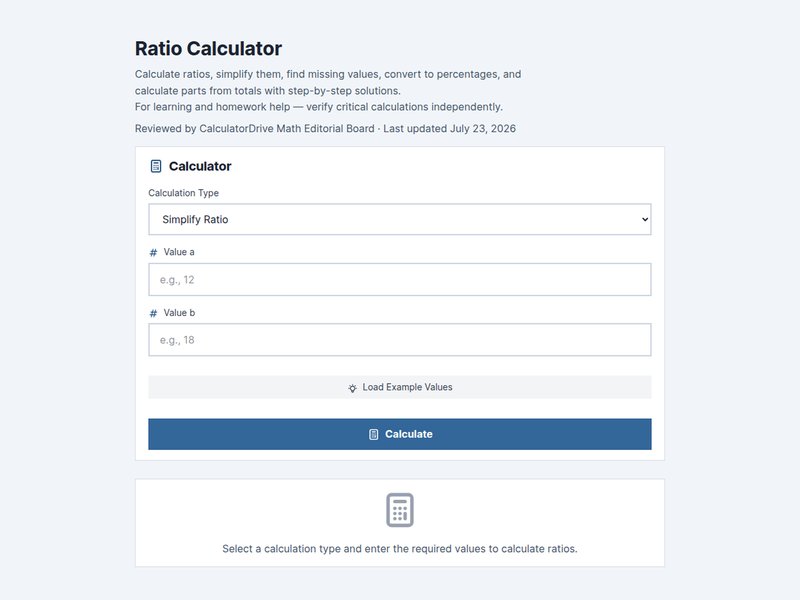
What makes ratios useful is that they compare quantities to each other without committing to units or totals. That's also what makes them slippery. There are only three things you'll ever do with a ratio — simplify it, scale it, or solve for a missing part — and the ratio calculator handles all three. This guide explains what it's doing, and clears up the one confusion behind most wrong answers.
First, the mistake that matters most
A ratio of 1:3 is not the fraction 1/3.
Read it slowly. In 1:3 there's one part of the first thing and three parts of the second, which means four parts in total. The first quantity is therefore 1/4 of the whole — 25%, not 33%.
If squash is mixed 1:3 with water, the squash is a quarter of what's in the glass. If a question asks "what fraction of the mixture is cement", add the parts together before you do anything else.
This single confusion produces more wrong ratio answers than everything else combined, and it's easy to see why: the notation looks like a fraction with the line turned sideways. It isn't. A ratio compares part to part; a fraction compares part to whole. If you genuinely want part-of-whole arithmetic, the fraction calculator is the better tool for the job.
Simplifying a ratio
Divide every part by their greatest common divisor — the largest number that goes into all of them exactly.
Take 18:24. The GCD is 6:
- 18 ÷ 6 = 3
- 24 ÷ 6 = 4
So 18:24 becomes 3:4. Identical relationship, friendlier numbers. Ratios that reduce to the same simplified form are called equivalent — 18:24, 9:12 and 3:4 all describe exactly the same thing, which is why simplifying is the quickest way to check whether two ratios match.
This is exactly how aspect ratios work
People treat "16:9" as a piece of marketing jargon. It's just a simplified ratio.
A 1920×1080 screen: the GCD of 1920 and 1080 is 120. Divide through — 1920 ÷ 120 = 16, 1080 ÷ 120 = 9 — and there's your 16:9.
Older 1024×768 monitors have a GCD of 256, giving 4 and 3: the classic 4:3 shape that made everything look almost square. If you need the GCD on its own for other work, the greatest common factor calculator finds it directly.
Scaling a ratio
Back to the bread. Flour and water at 3:2, and you have 750 g of flour.
The flour side went from 3 to 750, so it's been multiplied by 250. Apply the same multiplier to the other side: 2 × 250 = 500 g of water. Done.
You can also go straight there: water = 750 × (2 ÷ 3) = 500. The second route is faster whenever the multiplier isn't a whole number, which in real recipes it usually isn't.
The rule underneath both: whatever you do to one part, do to every part. Scale one side only and you haven't scaled the ratio — you've changed it, and your bread will tell you so.
Unit rates: the ratio that makes comparison easy
Sometimes the most useful move is reducing a ratio so one side equals 1. That's a unit rate, and it's how you compare things that aren't packaged alike.
Two bags of rice. One is 750 g for £2.40, the other 1.2 kg for £3.60. Which is better value? The totals don't compare and neither do the weights, so reduce both to price per 100 g:
- 750 g bag: 2.40 ÷ 7.5 = 32p per 100 g
- 1.2 kg bag: 3.60 ÷ 12 = 30p per 100 g
The bigger bag wins, but only by 2p per 100 g — a much smaller margin than "it's the big one, obviously" suggests. Unit rates are also why 3:2 is sometimes written as 1.5:1. Same relationship, expressed per single unit.
Solving a proportion
A proportion is just a statement that two ratios are equal. When 3:4 = 9:x, cross-multiply:
- 3x = 4 × 9 = 36
- x = 36 ÷ 3 = 12
Then check it the lazy way — simplify your answer and see whether you get back where you started. 9:12 divided through by its GCD of 3 gives 3:4. It matches, so the answer's right.
This is the shape of most real scaling problems: map distances, model sizes, currency conversion, working out how much paint a bigger wall needs.
Splitting a total by a ratio
This is the one that turns up in wills, partnerships and playground arguments, and it's where the parts-versus-whole rule earns its keep.
Split £5,000 between three partners in the ratio 2:3:5.
- Add the parts. 2 + 3 + 5 = 10 total parts. This is the step people skip.
- Find one part. 5,000 ÷ 10 = £500.
- Multiply out.
- 2 parts = £1,000
- 3 parts = £1,500
- 5 parts = £2,500
Always check the shares add back to the original total: 1,000 + 1,500 + 2,500 = 5,000. If they don't, you divided by the wrong number of parts — nine times out of ten because you forgot to add them up first.
Ratios, fractions and percentages side by side
These three describe the same relationships in different languages, and being able to move between them is most of the skill.
| Form | What it compares | 1 part to 3 parts |
|---|---|---|
| Ratio | Part to part | 1:3 |
| Fraction | Part to whole | 1/4 |
| Percentage | Part to whole, per 100 | 25% |
All three describe an identical mixture. The only question is whether the denominator is the other part or the total.
Turning a ratio into percentages
This comes up constantly — someone hands you a ratio and wants a percentage split. The method is the same one you've already used: add the parts, then divide each part by that total.
For 3:4, the parts total 7:
- 3 ÷ 7 = 0.4286 → 42.86%
- 4 ÷ 7 = 0.5714 → 57.14%
They add to 100%, which is your check — if your percentages don't total 100, you've divided by a part instead of the whole. A three-part ratio works identically: 2:3:5 has ten parts, giving 20%, 30% and 50%.
Notice how much friendlier 2:3:5 is than 3:4. Ratios whose parts total 10 or 100 convert to percentages in your head; the rest need dividing. Our percentage guide covers the conversions in more depth, and the percentage calculator handles the arithmetic.
Watch the units
One quiet trap: both sides must be in the same unit before you simplify. 500 g compared to 1 kg is 1:2, not 500:1. Convert first, simplify second.
This catches people constantly in recipes (grams versus kilograms), in maps (centimetres versus kilometres) and in anything involving time. A ratio is only meaningful when both sides are measuring in the same currency, literally or otherwise.
The mistakes worth watching for
- Reading 1:3 as one third. It's one quarter — four parts in total.
- Forgetting to add the parts before dividing a total.
- Scaling only one side. Every part gets the same multiplier or the ratio changes.
- Mixing units. Convert to a common unit before simplifying.
- Assuming order doesn't matter. 3:2 and 2:3 are different ratios. Write down which quantity is which.
Frequently asked questions
How do I simplify a ratio?
Divide every part by their greatest common divisor. For 18:24 the GCD is 6, which gives 3:4.
Is a ratio the same as a fraction?
No. A ratio compares one part to another part; a fraction compares a part to the whole. The ratio 1:3 is the fraction 1/4, because there are four parts altogether.
How do I split an amount in a given ratio?
Add the parts to get the total, divide the amount by that total to find one part, then multiply out. £5,000 split 2:3:5 gives £1,000, £1,500 and £2,500.
How do I work out an aspect ratio?
Simplify width:height by their greatest common divisor. 1920:1080 has a GCD of 120, which reduces to 16:9.
How do I compare two different-sized packets for value?
Reduce both to a unit rate — price per 100 g, per litre, whatever suits. A 750 g bag at £2.40 is 32p per 100 g; a 1.2 kg bag at £3.60 is 30p.
Is the ratio calculator free?
Yes. The ratio calculator is free, needs no sign-up, and runs in your browser. Browse everything on the math calculators page.
How We Created This Guide
Simplifications were computed using the greatest common divisor and verified against the CalculatorDrive Ratio Calculator. Multi-part ratio splits were checked by confirming the parts sum back to the original total.
Sources & References
Formulas, conventions and worked examples in this guide follow standard mathematical references and published standards bodies:
Accuracy note: Worked examples here are rounded for readability, and calculators can legitimately disagree in the last decimal place because of floating-point storage and differing rounding rules. For graded coursework or financial reporting, follow the rounding convention your instructor, standard, or regulator requires.
Written by
sami
No comments yet. Be the first to comment!