
About This Guide
Written for anyone working out a discount, a tip, a test score, or a change between two figures. It separates the three different questions the word "percentage" hides, gives the formula for each, and shows the reverse calculation most people get wrong.
A jacket is marked "£60 — was 20% more". A report says inflation "rose 5%" when the rate went from 40% to 45%. A shop advertises "20% off, then another 10% off" and calls it 30%.
All three of those involve percentages, and all three are asking genuinely different questions. That's the real difficulty with percentages: one word covers at least three separate calculations, and picking the wrong one gives you a confident, tidy, wrong answer.
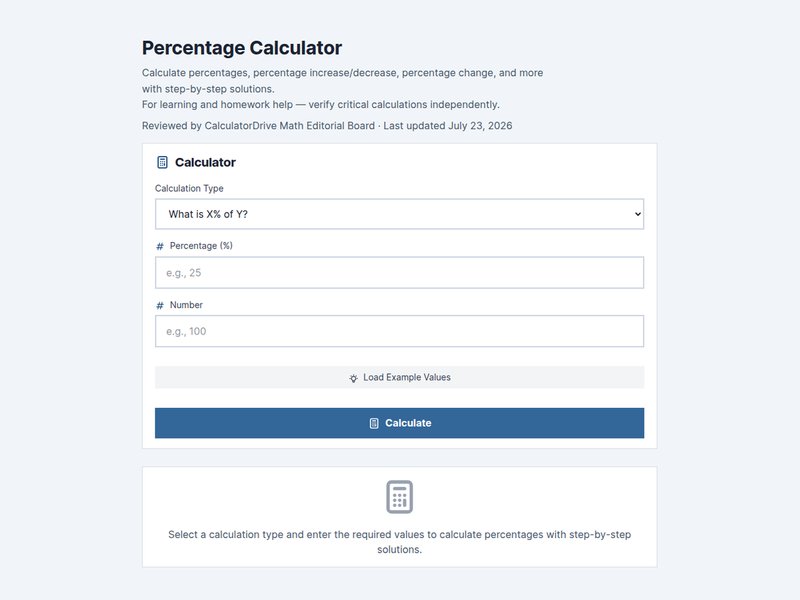
This guide separates them out. You can run any of it through the percentage calculator, but the point here is knowing which question you're actually asking.
Start with what the word means
"Per cent" means "per hundred". That's it. 40% is 40 out of 100, which is the fraction 40/100, which is the decimal 0.4.
Every calculation below falls out of that one fact. Before a percentage can do anything useful in arithmetic, divide it by 100. Once it's a decimal, it behaves like any other number, and most of the mystery evaporates.
Question 1: What is X% of Y?
Formula: Y × (X ÷ 100)
15% of 80 = 80 × 0.15 = 12.
This is the tips-and-discounts case, and the one most people already handle comfortably. An 18% tip on a £47.50 bill is 47.50 × 0.18 = £8.55. If you want the total in one step rather than two, multiply by 1.18 instead and get £56.05 directly.
Doing it in your head
Find 10% by shifting the decimal point one place left, then build from there. For 15% of 80: 10% is 8, half of that is 4, so 15% is 12. Want 20%? Double the 10%. Want 5%? Halve it. Want 1%? Move the point two places instead.
Almost every percentage you meet in a shop or restaurant can be assembled from 10%, 5% and 1% without touching a calculator.
The trick nobody teaches you
Percentages are reversible. X% of Y always equals Y% of X.
That sounds like a curiosity until you use it. 18% of 50 is awkward. Flip it: 50% of 18 is just half of 18, which is 9. Same answer, no effort. Or 4% of 25 — flip to 25% of 4, which is 1.
It works because both are really the same multiplication with the numbers swapped round. Whenever one side is a friendly number like 50, 25 or 10, flip it.
Question 2: X is what percent of Y?
Formula: (X ÷ Y) × 100
18 out of 45 = (18 ÷ 45) × 100 = 40%.
This is the test-score, market-share, conversion-rate case. The whole always goes on the bottom. If your answer comes out above 100%, either the part really is bigger than the whole (possible for growth figures) or you've got the two numbers the wrong way round — and the second is far more likely.
Question 3: What's the percentage change from X to Y?
Formula: ((Y − X) ÷ X) × 100
The original value goes on the bottom. This is the single most common percentage error there is, and it's worth slowing down for.
Going from 40 to 52: (52 − 40) ÷ 40 = 12 ÷ 40 = 0.30, a 30% increase.
Increases and decreases aren't mirror images
Here's where intuition fails. Going back down from 52 to 40 is not a 30% decrease. It's (52 − 40) ÷ 52 = 23.08%, because the starting point changed, and with it the denominator.
This isn't a technicality. It has consequences people meet in real life:
- An investment that drops 50% needs a 100% gain to break even, not another 50%. £100 falls to £50; gaining 50% of £50 only gets you to £75.
- A price that rises 10% and then falls 10% doesn't return to where it started. £100 → £110 → £99. The 10% coming off is 10% of a bigger number than the 10% that went on.
Whenever percentages are applied one after another, they compound. They don't add.
Which is why "20% off, then 10% off" isn't 30% off
Take £100. Knock off 20% and you're at £80. Knock 10% off that and you're at £72 — because the second discount only applies to the £80, not the original £100.
A straight 30% discount would have given you £70. The stacked version is worth £2 less. Shops know this. It's not a scam, but it isn't the bargain the signage implies either.
Reverse percentages: working backwards
You see a coat at £60 after a 20% discount. What was it before?
The instinct is to add 20% to £60 and land on £72. That's wrong, and it's wrong for a reason worth internalising: the 20% was taken off the original price, not off £60.
So £60 represents 80% of the original. To get back:
Original = 60 ÷ 0.80 = £75
Check it: 20% of 75 is 15, and 75 − 15 = 60. That works.
The general rule — to undo a percentage that's already been applied, divide rather than multiply. Divide by (1 − rate) to undo a decrease, or by (1 + rate) to undo an increase.
This is exactly how you strip VAT or sales tax out of a gross figure. A £120 total that includes 20% tax has a net value of 120 ÷ 1.20 = £100, with £20 of tax. Subtracting 20% of £120 would have given you £96 and a £24 tax figure — both wrong, and wrong in a way that a tax inspector will notice.
Percentage points aren't percentages
If an interest rate moves from 40% to 45%, has it risen by 5% or 12.5%?
Both, depending on what you mean — which is precisely the problem. It's a rise of 5 percentage points (the absolute gap between the two figures) and a 12.5% relative increase (because 5 ÷ 40 = 0.125).
Reporting "rates rose 5%" when you mean 5 percentage points is genuinely ambiguous, and it's why careful financial and statistical writing insists on the distinction. Whenever you read a percentage change of a figure that is itself a percentage, stop and work out which one is meant. Often the difference is large.
Worked example: discount, then tax
An £85 jacket, reduced by 30%, with 8% tax added at the till.
- After the discount: 85 × 0.70 = £59.50
- After tax: 59.50 × 1.08 = £64.26
An interesting wrinkle: because both steps are multiplications, the order doesn't matter. Apply the tax first and discount second and you still land on £64.26. That's a property of multiplication rather than a general rule about percentages — and it stops being true the moment a flat fee enters the calculation, because addition and multiplication don't commute with each other.
The mistakes worth watching for
- Using the new value as the base in percentage change. The original value is always the denominator.
- Adding a percentage back to reverse it. Divide by (1 − rate) instead. £60 after 20% off was £75, not £72.
- Treating stacked discounts as additive. 20% then 10% is 28% off, not 30%.
- Confusing percentage points with percent. 40% to 45% is 5 points, or a 12.5% rise.
- Adding percentages of different totals. 10% of one number plus 10% of another isn't 20% of anything meaningful.
Where to go next
For measurement accuracy against a known true value, the percent error calculator is the right tool. When you're comparing quantities to each other rather than to a whole, that's a ratio — see the ratio calculator and our guide to ratios, which explains when to reach for which. And if your percentage answers are coming out with more decimals than you want, our rounding guide covers where to cut them off.
Frequently asked questions
How do I calculate percentage change?
Subtract the old value from the new one, divide by the old value, then multiply by 100. From 40 to 52: (52 − 40) ÷ 40 × 100 = 30%.
How do I find the original price before a discount?
Divide the sale price by (1 − the discount as a decimal). A £60 item after 20% off was 60 ÷ 0.80 = £75. Don't add the percentage back — that gives the wrong answer.
Is 20% off then 10% off the same as 30% off?
No. On £100 the stacked discounts give £72, while a straight 30% gives £70. The second discount only applies to the already-reduced price.
Why doesn't a 50% gain undo a 50% loss?
Because the second percentage applies to a smaller base. £100 falling 50% leaves £50, and 50% of £50 is only £25, taking you to £75. You need a 100% gain to recover.
What's the difference between percent and percentage points?
Percentage points measure the absolute gap between two percentages — 40% to 45% is 5 points. Percent measures the relative change between them, which for that same move is a 12.5% increase.
Is the percentage calculator free?
Yes. The percentage calculator is free, needs no sign-up, and runs in your browser. Everything else is on the math calculators page.
How We Created This Guide
All percentage examples were computed programmatically and verified against the CalculatorDrive Percentage Calculator, then re-checked by hand. We distinguish percentage points from percent change throughout, because conflating the two is the single most common error in reporting figures.
Sources & References
Formulas, conventions and worked examples in this guide follow standard mathematical references and published standards bodies:
Accuracy note: Worked examples here are rounded for readability, and calculators can legitimately disagree in the last decimal place because of floating-point storage and differing rounding rules. For graded coursework or financial reporting, follow the rounding convention your instructor, standard, or regulator requires.
Written by
sami
No comments yet. Be the first to comment!